

Why do some HER2-expressing metastatic breast cancers resist T-DXd? New research points to S100-RAGE signaling as one answer.
Trastuzumab deruxtecan (T-DXd) has dramatically expanded treatment options for patients with HER2-expressing metastatic breast cancer. But even with the antibody-drug conjugate’s strong activity, some tumors fail to respond from the outset, highlighting an important problem of intrinsic resistance.
Now, Houston Methodist researchers may have identified one of those resistance mechanisms — and found a way to block it.
In a study published in Clinical Cancer Research, a team of investigators led by Stephen Wong, Ph.D., Dr. Hong Zhao and Wenjuan Dong, Ph.D., identified activation of the S100-RAGE signaling pathway as a potential mechanism of intrinsic T-DXd resistance across metastatic breast cancer sites.
Blocking RAGE restored T-DXd sensitivity in laboratory studies and significantly reduced metastatic burden in animal models, providing a rationale for translating the combination strategy into clinical testing.
“The problem is that we don’t have a good marker to identify who will be resistant to T-DXd,” said Dr. Wong, senior author on the study and the John S. Dunn Presidential Distinguished Chair in Biomedical Engineering at Houston Methodist. “What this study identified is a biological mechanism that may help explain that resistance.”
Looking beyond HER2
The investigation began with a familiar problem for oncologists: HER2 expression alone does not tell the full story of response.
Among 47 patients contributing 109 metastatic lesions, HER2 status, estrogen and progesterone receptor status, Ki-67 index and metastatic location were not significantly associated with T-DXd response. These findings highlighted an important clinical gap: conventional tumor markers can identify patients eligible for T-DXd but do not necessarily explain why individual tumors respond or resist treatment.
This prompted the researchers to look deeper — not simply at which molecular targets were present, but at how tumor cells, immune cells and signaling pathways were organized and interacting within the tumor microenvironment.
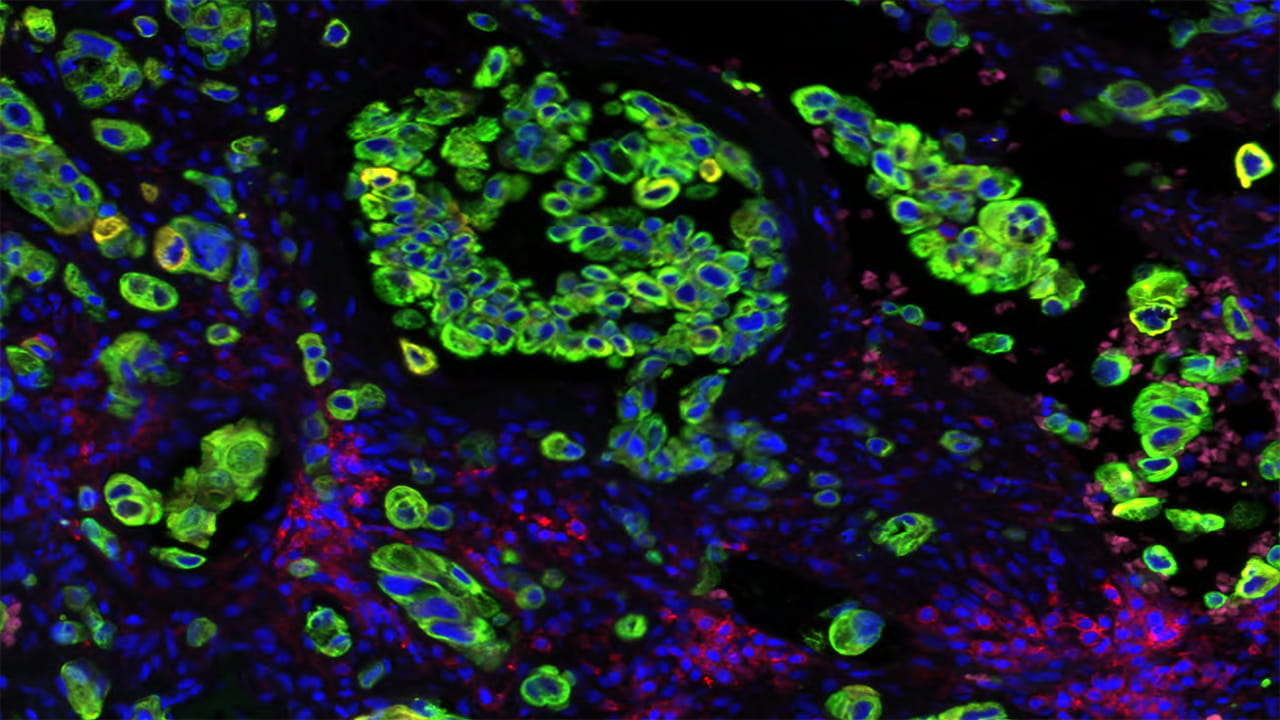
Using spatial transcriptomic and proteomic profiling, the team mapped gene and protein activity within specific tumor and immune-cell neighborhoods rather than averaging signals across an entire tissue sample.
That distinction is central to Dr. Wong’s approach.
“Traditional biology often looks at one protein or one gene and tries to dig deeply into that pathway,” Dr. Wong explained. “Systems biology lets us move beyond studying one molecule at a time. By combining spatial data with computational modeling, we can examine many interacting pathways simultaneously and identify those most likely to drive resistance.”
Spatial analysis adds another layer: location. Conventional single-cell sequencing can identify molecular differences between cells but loses information about where those cells were positioned and which cells surrounded them. By preserving that context, Dr. Wong said, investigators can begin studying the molecular “conversations” occurring between tumor cells and their neighboring cells.
The approach revealed striking differences between T-DXd-responsive and T-DXd-resistant tumors. Responding lesions showed greater intermixing between tumor and immune cells, while resistant lesions tended to form denser tumor structures with relatively little immune penetration.
At the same time, resistant tumors across bone, brain and soft-tissue metastases repeatedly demonstrated increased expression of S100-family proteins, including S100A7, S100A9 and S100P. These signals converged on RAGE, a receptor capable of activating downstream survival pathways that can help tumor cells withstand therapeutic stress.
Turning a resistance mechanism into a therapeutic target
Finding the S100-RAGE signature was only the first step. Researchers next asked whether it was simply associated with resistant cancers or actively helping the cancer cells survive the treatment.
When they combined T-DXd with the RAGE inhibitor TTP488, cancer cells became substantially more sensitive to T-DXd and showed increased apoptotic signaling. Genetic depletion of RAGE also sensitized tumor cells to T-DXd, providing additional evidence that RAGE functionally contributes to resistance. In metastatic mouse models, combination treatment reduced the number and size of metastases and overall tumor burden more effectively than T-DXd alone.
“RAGE is more than a marker associated with resistant tumors — it appears to contribute functionally to resistance, and when we inhibit it, we find that T-DXd works better.”
Stephen Wong, Ph.D.
TTP488 also offers an important translational advantage: it is an orally available drug that has already undergone human clinical testing, allowing investigators to consider a combination strategy without developing an entirely new agent from scratch.
Dr. Wong said Houston Methodist has begun moving the concept into clinical investigation and is currently enrolling patients in a study designed to evaluate RAGE inhibition alongside T-DXd.
A new way to interrogate treatment resistance
The significance of the research may extend beyond a single pathway or drug combination.
The spatial cohort was necessarily limited because high-quality pretreatment samples from metastatic sites such as bone and brain are difficult to obtain, and the animal studies used immunodeficient models that cannot fully reproduce the immune interactions seen in patients. Additional validation will therefore be necessary.
Dr. Wong also emphasized that S100-RAGE is unlikely to account for every case of T-DXd resistance. His team is continuing to search for other pathways using the same computational-spatial strategy.
That may ultimately be the broader innovation: changing the search itself.
Rather than choosing a gene or protein and spending years testing it in isolation, spatial proteogenomics allows investigators to examine many molecular interactions simultaneously, identify the most promising drivers and then test whether disrupting those relationships changes therapeutic response.
“Cancer is really a crosstalk dysfunction,” Dr. Wong said. “Mutations and proteins are important, but modern spatial technology makes it possible to investigate another layer — how abnormal cells interact with their surroundings to produce disease.”
For oncologists, that could eventually mean moving beyond asking whether a tumor carries the right target for therapy and toward understanding whether its surrounding molecular ecosystem is primed to respond.
“This is really a methodology change and a conceptual change,” Dr. Wong said. “The broader goal is not just to overcome resistance to one drug. It is to systematically identify the cellular interactions that allow tumors to escape therapy and then turn those resistance mechanisms into therapeutic vulnerabilities.”